
India, a country rich in biodiversity, offers great potential for wildlife tourism. Its diverse landscapes and habitats provide various opportunities for wildlife safaris across the country. Even to see the same animal in different habitats, you need to choose different types of safaris. For example, in the Sundarbans and Kanha, both locations offer tiger sightings; in Kanha, you view tigers from a jeep, while in the Sundarbans, you see them from a boat. Kanha provides a jeep safari, whereas the Sundarbans offers a boat safari through creeks in the mangrove delta.
The Sundarbans Delta: Where the Tiger Swim
Lying on the delta of the mighty Ganges, Brahmaputra, and Meghna rivers is a network of dense forests and water channels, called “the Sundarbans,” the world’s largest mangrove forests. In these deltas, the boundary between the water and land merges on every high tide and is exposed when the water recedes. A UNESCO World Heritage Site, Sundarbans is the only mangrove in the world inhabited by tigers.
The safari in these deltas is only possible by boat. It looks like the forest is floating on creeks and channels, where the roots of mangroves protrude from the wet soil in search of oxygen, kingfishers flash their colorful wings, and mudskippers hop on exposed banks. The Royal Bengal Tiger behaves differently in this land, living an amphibious life. Saltwater crocodiles, monitor lizards, and mangrove pittas complete this amphibious kingdom.
The Sundarbans are not just a wilderness but a mystery, a shifting world where every tide redraws the map. A safari here is less about sightings and more about surrendering to a landscape that breathes with the sea.

The Grasslands: Land of the Rhino—Kaziranga, Assam
When you move upstream from the tangled roots of the Sundarbans delta, you will reach a place where the unicorn rules in the ocean of tall elephant grasses. Another UNESCO World Heritage Site, Kaziranga Tiger Reserve, is a place known as the home of two-thirds of the endangered Great Indian One-Horned Rhinoceros.
Though jeep safari is the main option here, a boat ride on the mighty River Brahmaputra offers an unparalleled wildlife experience. Here you will see the Gangetic River dolphin coming out to breathe for a second, and you will also see the giants of Kaziranga: rhinos, elephants, and buffaloes, and if you are lucky, then you might see a Bengal tiger. From the boat, you will have good birdwatching.
Kaziranga is known for its conservation of the Indian one-horned rhinoceros, with a few of them; the reserve now holds the distinction of having more than 2600 of them, which is due to conservation and protection by the forest department.

The Forest Heartland: The Tiger Country of Central India
Now, after finishing your safaris in Kaziranga, you travel westward towards the central India. Known for two hill ranges, Central India is the best place for a tiger safari in India. The moist and dry deciduous forests of Madhya Pradesh (Central Province) are a perfect habitat for tigers. Tiger reserves like Kanha, Bandhavgarh, Pench, and Satpura offer one of the best wildlife experiences in Central India. These reserves are known for their tiger sightings and for other typical central Indian fauna.
In Kanha, you will also get to see the hard ground barasingha, or swamp deer, a subspecies saved from extinction in the rolling meadows. A backdrop of fortress cliffs and bamboo thickets, Bandhavgarh is known for its tigers and landscape. Pench was the inspiration behind the Rudyard Kipling classic ‘The Jungle Book.’
You will do a Jeep safari here on well-designated forest roads, which is a major mode of safari here. Apart from the Jeep safari, there are boat safaris in some reserves as well as walking safaris.

The Arid, Semi-arid, and Desert: Ranthambhore, Jawai, and the Great Indian Bustard’s Last Haven
Now you go further west, towards the western part of India, where you will get to see arid, semi-arid, and desert landscapes and animals adapted to this kind of habitat. The major reserves are Ranthambore Tiger Reserve, Jawai Leopard Conservation Reserve, and Desert National Park.
Ranthambhore Tiger Reserve is famous for its tigers and beautiful landscape with an ancient fort in the backdrop. Here, jeep safari is the main mode of park visit. Ranthambore is one of the best representatives of the northwesternmost tiger habitat and supports a sizeable population of tigers, leopards, and sloth bears along with the prey species like spotted deer and sambar deer. The reserve is dotted with various lakes and ancient ruins of the Rajput kingdom.
Jawai is a village where the landscape is dominated by large granite boulders, which is a perfect habitat for the leopard. In Jawai, the leopard sightings are either by Jeep, or you will see them sitting in the verandah of your lodge.
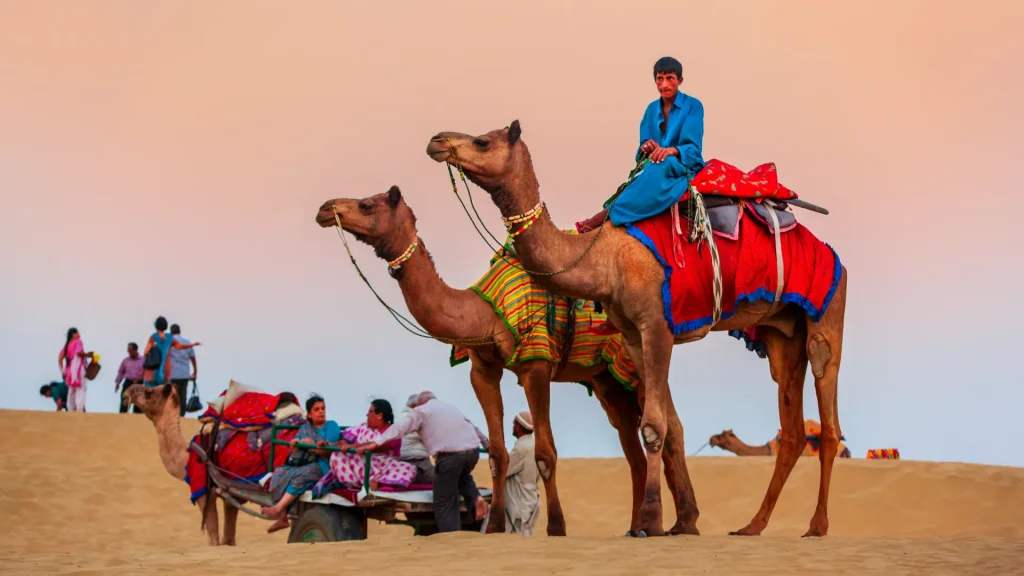
The Desert National Park is situated close to the historical city of Jaisalmer and is famous for its dunes and desert fauna, especially the Great Indian Bustard, a critically endangered species of bird that survives only in a few places in India. This park is the best place to observe the desert fauna of India, and most of them you will see even without entering the park.

The High Himalayas: Realm of the Snow Leopard – Ladakh & Spiti
Travel north from the desert to the Himalayas and the trans Himalayas, where things are very different.
You can observe the great variety of plants and animals in the Himalayas on foot on most of the safaris here. Valley of Flowers National Park lies in the Garhwal Himalayas and is a UNESCO World Heritage Site. It’s a great spot to begin your journey.
Now, after your Himalaya journey, you should go to the high-altitude trans Himalayas to look for snow leopards, Pallas’ cats, and brown bears. It’s worth it, even though the temperature is below zero and there is less oxygen here. It isn’t easy to find snow leopards; trackers go in different directions to look for them. If they see one, they tell all the lodges, and then they take you to the nearest road, from where you have to walk to the nearest place from where you may see the snow leopard, usually from a distance. Apart from the snow leopard, you will see the Himalayan Ibex, Tibetan argali, red fox, Tibetan Wolf, and birds like Chukar partridge, Golden eagle, Black-billed magpie, and blue rock thrush, etc.

The Western Ghats: Rainforest Rhythms of the South
The Western Ghats, running along India’s western coast, are one of the most biodiverse areas in India. Due to its altitudinal variations and microclimatic conditions, it harbors many species of plants and animals that are endemic to this region. In reserves like Periyar, Kabini, and Wayanad, elephants, gaur, leopards, and the rare & endemic lion-tailed macaque & Nilgiri langurs inhabit dense tropical evergreen & deciduous forests.
On a boat safari on Periyar Lake, you will see a herd of elephants drinking water from the shore, while in Kabini, in the summer months, large herds of elephants gather around the water body, which is considered the largest congregation of Asian elephants. For birders, the Western Ghats are paradise, from Malabar trogons and Nilgiri wood pigeons to the haunting call of the Malabar whistling thrush.
You can conduct safaris in this landscape by boat, on foot, or by jeep. Those who are interested in small things in nature can explore the rich, dense evergreen forests on foot.
Every Indian landscape is also a cultural landscape. The boatmen of the Sundarbans, who navigate tides guided by superstition and skill; the Bishnoi of Rajasthan, protectors of trees and antelope; the Mishing tribes of Assam, who live in rhythm with the floods; the monks of Ladakh, who share their valleys with snow leopards—these communities are an integral part of the safari as the wildlife itself.
India’s wildlife survives not just because of protected areas and the forest department, but because of traditions, beliefs, culture, and coexistence that local communities have followed for years. Responsible tourism today builds on these strong pillars of sustainability, offering travelers the chance to witness not just animals, but entire living cultures of conservation.

Conclusion: A Journey Through Living Landscapes
From the delta to the desert, from deciduous forests to cold deserts, India’s safari map reads like a book, every region a new chapter, every landscape a new vista of life. Nowhere else can you sail through mangroves one season and trek across glaciers the next, watch a tiger sitting in a lake in summer, and later in winter spot a snow leopard stalking ibex in the trans Himalaya.
To travel across these wild landscapes is to witness not just India’s biodiversity but also its culture, traditions, philosophy, and belief. A journey through India’s diverse safaris isn’t merely travel; it’s a pilgrimage through the living geography of the natural world.


